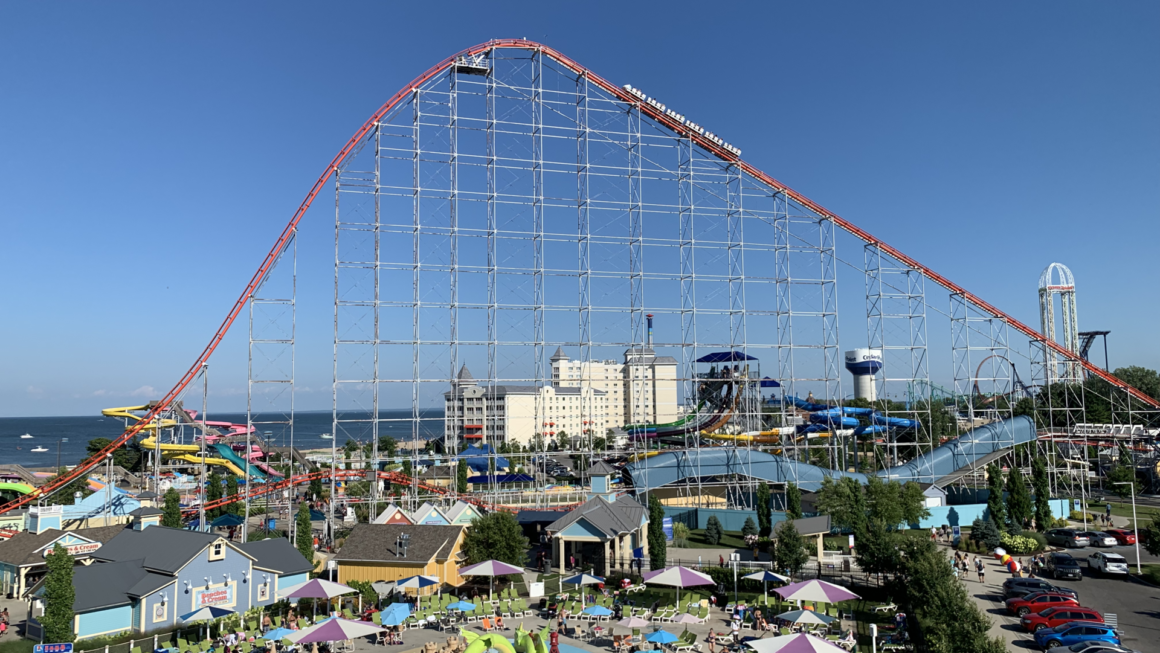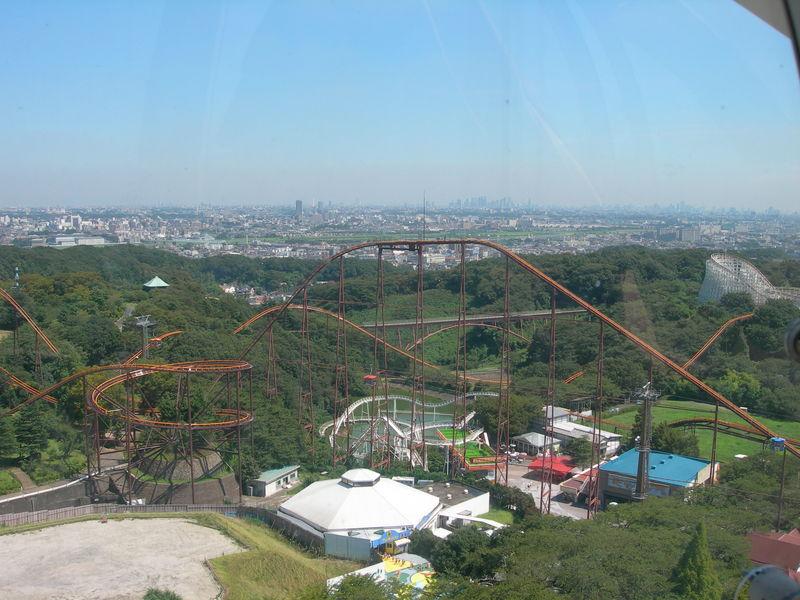
Tucked among the cherry blossoms of Japan lies a coaster that perfectly captures the essence of our Captivating Coasters series. Iconic, unique, and often overlooked, this month we’re taking things international, so grab your passport and join us in Tokyo as we take a look at Bandit, a hidden gem at Yomiuriland. Bandit isn’t just a thrill ride, it’s a trailblazer. This lesser-known coaster helped inspire the very ride that kicked off the most revolutionary era in roller coaster history.
Bandit, Yomiuriland (Tokyo, Japan)
Manufacturer:
TOGO
Model:
Super Roller Coaster
Ride Statistics:
Ride Length – 5,118 Feet
Height – 167 feet
Top speed – 68 miles per hour
Duration – 2 minutes 18 seconds
Media:
On-ride point of view – Credit: National Coasters
Off-ride video – Credit: Airtime Thrills
History:
Bandit opened on March 25th, 1988. It briefly held the record for tallest and fastest roller coaster in the world, standing at a height of 167 feet and reaching a top speed of 68 miles per hour. These records lasted just over a year before being overtaken by last month’s captivating coaster, Magnum XL-200. What made Bandit notable, aside from these records, was the way it deviated from the trends of the time. While most steel coasters of the time focused on inversions or were inverted coasters, such as The Bat at King’s Island, Bandit took a different route.
Redefining the Steel Coaster:
Built by TOGO, a manufacturer known for its unconventional ride designs, Bandit took a unique approach to the ride experience of a steel coaster. Bandit focused on negative G-forces, the forces that create the airtime on rides. This gave it a ride experience more in line with the wooden coasters of the time, such as Phoenix at Knoebel’s Amusement Resort and Grizzly at King’s Dominion, focusing on speed, lateral forces, and airtime over inversions.
Why it is Captivating:
Bandit is one of the most influential roller coasters of all time, and yet it is largely unrecognized outside of the enthusiast community. While it wasn’t the ride that officially launched the golden era of coaster innovation, it served as the catalyst for the one that did. In an era when steel coasters were dominated by inversion-heavy designs, like the iconic Arrow loopers and Schwarzkopf models, Bandit proved that a coaster could be marketable and successful without relying on inversions. Instead, it showcased the appeal of height, speed, and airtime-focused layouts.
Influencing an Icon:
Dick Kinzel, then CEO of Cedar Point, and Ron Toomer, took the concept that Bandit proved worked and built upon it by striving for a ride that not only broke the height record, but also was the first coaster to surpass 200 feet. Without Bandit laying the groundwork, who knows how long we would have waited for the first hyper coaster to be built. Unfortunately, likely due to being located overseas, Bandit is rarely mentioned among the most influential coasters of all time, a disappointing oversight for a ride with such significance. Today, it’s nearly impossible to find a major amusement park without at least one hyper coaster in its lineup, and most of these rides follow the same formula Bandit developed, focusing on speed and airtime over inversions.
Bandit Today:
Despite being built over 35 years ago, Bandit remains the marque attraction at Yomiuriland. Its popularity endures thanks to a scenic layout that weaves through cherry blossoms and plunges into a forested valley, offering a ride experience unlike anything else. While the over-the-shoulder restraints can detract from comfort, and the ride having some profiling issues that make the transitions a bit jarring, Yomiuriland maintains Bandit well, ensuring it continues to operate reliably.
As many of you know, there’s about a 0.1% chance I’ll make it to Japan anytime soon, despite a desire to check out the great parks and culture. While I have not personally had the opportunity to experience Bandit, Jesiah Olson from National Coasters was gracious enough with his time to share his thoughts and experience on the ride.
Ask an Enthusiast (Jesiah Olson – National Coasters)
The Ride Experience:
Bandit is a bit of an odd one. I’ve now been to Yomiuriland twice (2023 and 2025) and I can say I was just as impressed / confused with the coaster both times. The attraction appears much larger than it actually is, because it sits on the mountain Yomiuriland is built around. That said, Bandit’s official structural height is 167 feet, while the apex of the coaster sits 256 feet above the lowest point on the ride. Unfortunately, not a hyper, but very cool nonetheless.
With that introduction, I’ll now discuss the ride experience. Bandit begins by exiting its station to the right, and greeting riders with a number of water cannons. (Because Japan is so hot in summer, Yomiuriland operates Bandit with a train that features this option). These cannons are positioned both right as the train exits the station and after the first drop—and I must say, it’s a pretty fun beginning to the ride, despite us getting absolutely drenched. Then you head up the initial lift, where there are amazing views out toward Shinjuku. It’s pretty panoramic and you can see lots of buildings.
From here, the rest of the ride is chaos. The first drop took us down to another pair of water cannons, where we slammed into a 180 degree turnaround that sent us flying back toward the lift. Immediately after, we were forced into a 540 degree helix that gets taken at speeds far too unreasonable for this ride. The transition into this helix feels like a car crash which blew me into the bulky, over-the-shoulder restraint. The helix itself does give some pretty good positives though, and is a nice switch up from the rest of the ride. A small dip down then follows this element, and is succeeded by a poorly profiled wave turn.
After that, we were surprised to find that there’s an airtime hill on Bandit that actually gives good airtime! It’s pretty drawn out and feels like a proper version of the speedhill on Goliath at Six Flags Magic Mountain. Impressed as we were, I was not prepared for the best part of the ride which was next to come.
Immediately following the airtime hill, Bandit banks right and drops all the way to the bottom of the valley situated below Yomiuriland. When in the front row, you can feel Bandit’s impressive speed here as you race down and back up into some trees. (Bandit was the fastest roller coaster in the world when it opened—and it shows!).
Then, you slam right again, enter what should be a midcourse brake run, experience a smaller valley drop, and an additional airtime hill. This “airtime” hill is more of a speedhill though and doesn’t provide too much airtime. Bank left and head up a small incline, and we found ourselves at the end of the ride.
Overall a super solid, yet janky experience that is well worth a ride in the front row! (Please note: This is a front row ride!!)
What, to you, makes Bandit Captivating:
From an enthusiast perspective, there are a number of reasons you might find Bandit interesting.
For one, when this thing opened it was not just the fastest roller coaster in Japan, but the fastest coaster in the world! Reaching a top speed of 68.4 miles per hour, Bandit held on to this record for a year and lost it to Magnum XL-200 at Cedar Point in 1989. Just a bit of history there.
It’s also a heavily terrain-based coaster, which means you won’t find this anywhere else—it’s completely unique. A lesser-known record Bandit also had at its opening, was the world record for the largest difference in elevation between the highest and lowest points of the ride. Although Bandit is 167.3 feet tall, the height from the bottom of the valley drop to the apexof the lift is 255.9 feet. Outside of the technical stuff, Bandit is also just visually stunning. Some of the best and most amazing sunsets take place behind Bandit. And it’s a TOGO!
Bandit’s Future:
Unlike a lot of other Japanese coasters, I think Bandit has a very long future ahead of it.
Bandit’s park, Yomiuriland, is easy to access from Tokyo, well taken care of, and also houses the Yomiuri Giants Stadium—making it an easy stop for fans watching baseball. From both of my visits to this park (one in winter and one in summer), I found it to be consistently busy and loved by guests.
Given Bandit is the star attraction at the park, I don’t see it going anywhere anytime soon. The ride is nearly 30 years old, and I suspect it will last another decade at least.
Jesiah’s Final Thoughts:
Bandit is a fun, exciting, and speed-oriented ride. The over-the-shoulder restraints may make it uncomfortable for some, but if you give yourself enough room the restraints are tolerable.
As for the layout, it is unique and full of interesting transitions. Some of these (namely the transition into the helix) can be very rough, but it gives the ride some charm.
I also find the setting to be spectacular, with the drop into the valley easily being the best part of this ride. The water cannons are a fun addition too and surprised our whole group.
Overall, I’d say Bandit is a B+ attraction. It has an awesome history, great location, and fun elements—just maybe a little rough for some. Worth a trip out for anyone visiting Tokyo for sure!
Conclusion
Bandit may not be well-known outside of the coaster enthusiast community, but its impact on the industry is undeniable. As we wrap up the September edition of Captivating Coasters I want to give a huge shout out again to Jesiah, if you are not following him and his team on YouTube, Facebook, and Instagram you are truly missing out on some of the best content out there. I sure hope he is correct on Bandit having a long future ahead so that maybe one day I will get a chance to ride it myself!
Come back next month to see what the next edition of Captivating Coasters has in store! And as always if you want to stay up to date on my latest content follow me on Instagram and Facebook to get notified anytime new content drops, and to follow my adventures as they happen!